Can an online quote tool replace the first site visit?
For many service businesses, the first estimate is the most expensive step in the sale. Here's when an instant quote tool can do that job, what it needs to get right, and when you still need to show up in person.
Ask a fence company, a landscaper, a roofer or a cleaning service where their week goes, and a surprising amount of it goes to quotes. Someone calls, a visit gets scheduled, a person drives out, measures, drives back, writes up a number and sends it. Then the customer goes quiet, because the price wasn’t what they expected or they were only shopping around.
For many service businesses the first estimate is the most expensive step in the sale, and much of that effort goes to people who were never going to buy. An instant quote tool on your website can take over that first step. Here’s when it works, what it needs to get right, and when you still need to show up.
What an instant quote tool does
A quote tool asks the customer for the handful of details that drive your price, does the math the way you would, and shows a realistic number straight away. The best ones feel less like a form and more like a design tool: the customer is planning their project, and the price updates as they go.
The customer gets an answer in minutes instead of days. You get a lead who has already seen a price and still wants to talk.
When it can replace the first visit
A quote tool works best when:
- Price follows a few measurable things. Length, area, quantity, material and a handful of options. If you could write your pricing down as a formula with a few adjustments, software can apply it.
- Customers can supply those measurements themselves, directly or with help. This is where maps and drawing tools make the difference.
- The first number doesn’t have to be final. A tight range or a “starting at” price is enough to qualify a lead, as long as the tool is honest that a final quote follows.
- You get a lot of tire-kickers. The more inquiries that never turn into jobs, the more an instant price saves.
An example: drawing a fence on a satellite map
Fencing is a good example, because the price mostly comes down to how much fence, what kind and how many gates, and all of that can be measured from above.
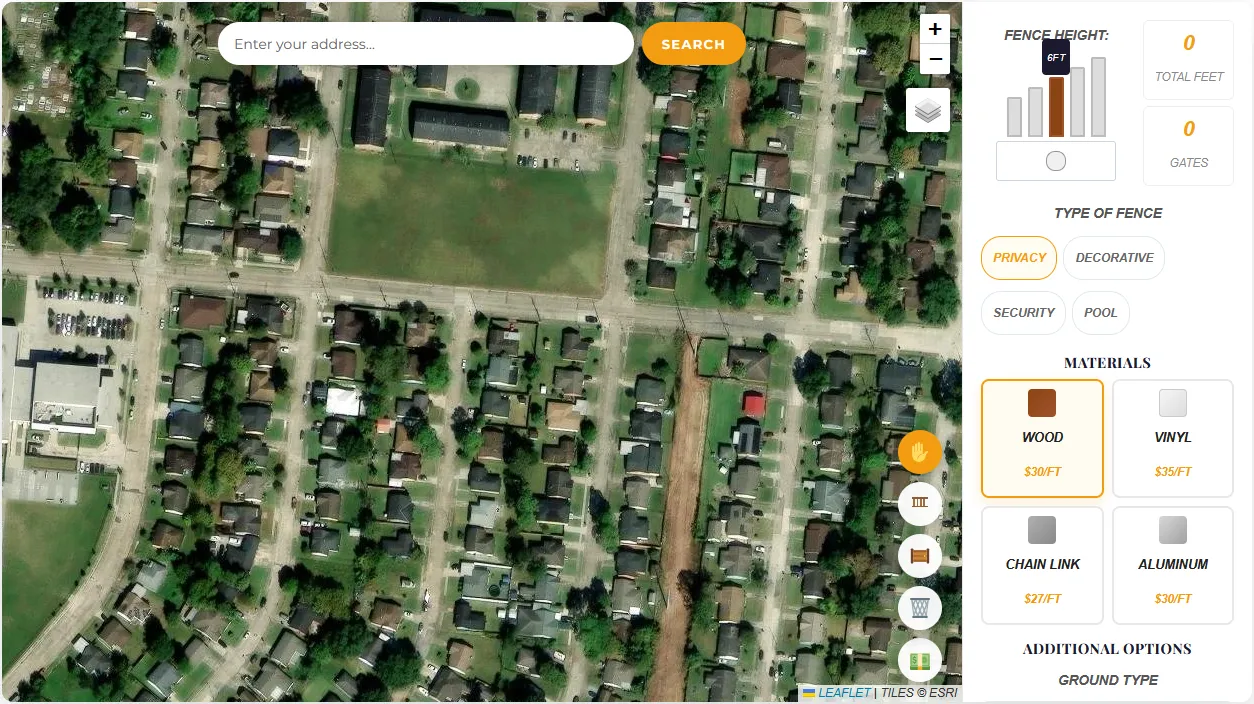
We built MapFence Estimator, a WordPress plugin that drops this kind of tool into a contractor’s website. The customer searches their address and lands on satellite imagery of their property. They trace where the fence should go and place the gates, and the plugin measures the footage as they draw. Then they choose a height, a style (privacy, decorative, security or pool) and a material (wood, vinyl, chain link or aluminum), each with its own price per foot, plus extras like ground type. The quote updates in real time as they make each choice. (Read the case study.)
What used to start with a site visit now starts with a customer who has already designed their fence and seen what it costs.
What a good quote tool gets right
- It’s built on your real pricing. The tool is only as good as the numbers behind it. Expect to spend time turning how you actually price jobs into rules, including the minimums and extras you usually add in your head.
- It’s honest about what’s included. Say clearly what the number covers and what could change it on site: removal of an old fence, rocky ground, permits.
- It works well on a phone. Many customers will use it from the yard they’re thinking about. Drawing and tapping have to feel easy on a small screen.
- It captures the lead. After showing the price, ask for contact details and send the full breakdown to both the customer and your team, so nothing gets lost.
- It’s easy for you to update. Material costs change. You should be able to adjust prices without calling a developer.
When you still need to show up
An online quote doesn’t replace expertise. Some jobs genuinely need eyes on site:
- conditions you can’t see from above, like slopes, drainage, soil or hidden utilities
- repairs and custom work, where every job is different
- commercial or high-value projects, where the customer expects a site meeting anyway
- anything with safety or code requirements that need checking in person
The goal isn’t to never visit a site. It’s to visit the right ones, for customers who already know roughly what they’re spending and have decided they want to go ahead.
Is it worth building?
A rough way to judge it: think about how many estimates you do in a month, how long each one takes including travel, and how many turn into jobs. If a large share of that time goes to people who never buy, a quote tool will pay for itself quickly. If most of your estimates close, the bigger win may be elsewhere.
Quote tools don’t have to be built from scratch, either. If your site runs on WordPress, a custom plugin can add one without rebuilding your website, which is how MapFence Estimator works.
Spending too much of your week on estimates? Tell us how you price your work, and we’ll tell you honestly whether an online quote tool would pay off. You can also read more about our web platforms and interactive tools.