BearSoft Lab
The Pillars of Creation, in 3D
Building the pillars…Drag to look around · Scroll to zoom · Select a marker to learn moreLook around with one finger · Pinch to zoom
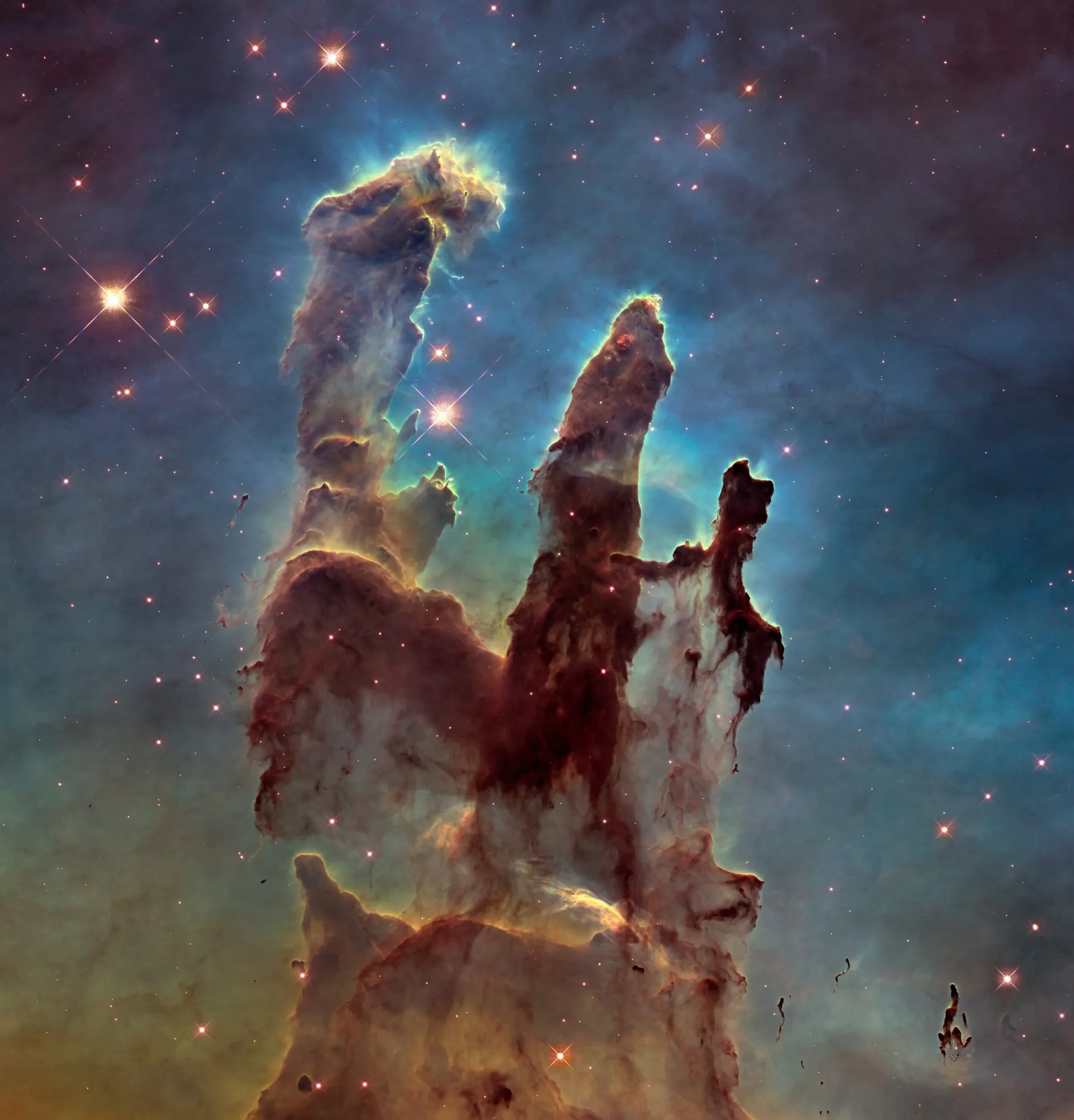
Image: NASA, ESA and the Hubble Heritage Team (STScI/AURA)
What you’re looking at
Three columns of gas and dust, light-years tall
The Pillars of Creation are towers of cold hydrogen gas and dust inside the Eagle Nebula. Hubble first photographed them in 1995 and again, in sharper detail, in 2014. The photograph this scene is built from is the 2014 one.
About four light-years tall
The tallest pillar, on the left, stretches about four light-years from base to tip: roughly 23 trillion miles.
Stars are forming inside
Dense knots of gas inside the pillars are collapsing under their own gravity into new stars. Some of the tips may hide young stars still wrapped in dust.
Eroding in starlight
Hot, young stars nearby flood the pillars with ultraviolet light, slowly boiling away their gas. The glowing edges are where it’s happening.
Inside the Eagle Nebula
The pillars sit inside the Eagle Nebula (M16), a vast cloud of gas and dust about 6,500 light-years away, in the constellation Serpens.
Light from long ago
The light in this image left the pillars around 6,500 years ago, before humans had invented writing.
How we built it
From a flat photo to a scene you can walk around
- We traced the pillars by hand. Color alone can’t tell the pillars from the gas around them, so their outline is drawn over the photo.
- The browser builds the scene from the photo, in a background thread, so the page stays responsive. Every point takes its color from Hubble’s image: up to 450,000 on a desktop, fewer on a phone.
- Depth comes from shape. The farther a spot is from a pillar’s edge, the thicker the pillar is there, which turns the outline into rounded columns. Gas is layered in front of and behind them.
- Stars are found automatically and placed in space, drawn with the same four-pointed spikes Hubble’s camera produces.
- It runs on WebGL, pauses when you scroll away, and switches the motion off for anyone who has asked their device to reduce motion.
Hubble’s photograph is flat, so the depth here is our reconstruction from the image, not a measured 3D model. It’s an interpretation, made to give a sense of scale and shape.
Image by NASA, ESA and the Hubble Heritage Team (STScI/AURA), from HubbleSite. Public domain, via Wikimedia Commons.
Want something like this for your brand?
Interactive 3D, data visualization or something nobody has built yet: tell us the idea and we’ll tell you what it takes.